#424 Peter Thiel on How to Build a Creative Monopoly
Episode
53 min
Read time
2 min
Topics
Startups, Leadership, Design & UX
AI-Generated Summary
Key Takeaways
- ✓Creative Monopoly Definition: Build a product so differentiated that no competitor offers a close substitute — not a coercive monopoly like Vanderbilt's shipping empire, but one like Apple or Amazon where dominance comes from solving a unique problem nobody else solves. All failed companies share one trait: they failed to escape competition entirely.
- ✓Start Deliberately Small, Then Expand: Every monopoly begins by dominating a niche market before scaling outward. Amazon started with books while internally calling the project "The Everything Store." If your initial market feels too large, it almost certainly is. Sequencing adjacent market expansion correctly — and with discipline — is consistently underrated by founders.
- ✓Durability Over Growth Metrics: Most of a tech company's value arrives ten to fifteen years post-founding — Nvidia's peak value came 25-30 years in. Growth is easy to measure; durability is not. The single most critical question founders should ask is whether the business will still exist a decade from now, not whether this quarter's numbers hit targets.
- ✓Distribution as Product Design: Superior sales and distribution alone can create a monopoly even without product differentiation — the reverse is never true. Founders should treat distribution as a core design element from day one, not an afterthought. Most businesses fail because of poor distribution, not poor product, and typically only one distribution channel needs to work.
- ✓Do One Thing Per Person: At PayPal, Thiel assigned each employee exactly one unique responsibility and evaluated them solely on that metric. The intended benefit was managerial simplicity, but the deeper result was reduced internal conflict. Internal conflict functions like an autoimmune disease in startups, and eliminating it extends how long a team can sustain collaboration.
What It Covers
David Senra revisits Peter Thiel and Blake Masters' Zero to One, examining how founders build creative monopolies by thinking from first principles, starting in deliberately small markets, sequencing expansion strategically, and prioritizing durability over short-term growth metrics across a decade-plus time horizon.
Key Questions Answered
- •Creative Monopoly Definition: Build a product so differentiated that no competitor offers a close substitute — not a coercive monopoly like Vanderbilt's shipping empire, but one like Apple or Amazon where dominance comes from solving a unique problem nobody else solves. All failed companies share one trait: they failed to escape competition entirely.
- •Start Deliberately Small, Then Expand: Every monopoly begins by dominating a niche market before scaling outward. Amazon started with books while internally calling the project "The Everything Store." If your initial market feels too large, it almost certainly is. Sequencing adjacent market expansion correctly — and with discipline — is consistently underrated by founders.
- •Durability Over Growth Metrics: Most of a tech company's value arrives ten to fifteen years post-founding — Nvidia's peak value came 25-30 years in. Growth is easy to measure; durability is not. The single most critical question founders should ask is whether the business will still exist a decade from now, not whether this quarter's numbers hit targets.
- •Distribution as Product Design: Superior sales and distribution alone can create a monopoly even without product differentiation — the reverse is never true. Founders should treat distribution as a core design element from day one, not an afterthought. Most businesses fail because of poor distribution, not poor product, and typically only one distribution channel needs to work.
- •Do One Thing Per Person: At PayPal, Thiel assigned each employee exactly one unique responsibility and evaluated them solely on that metric. The intended benefit was managerial simplicity, but the deeper result was reduced internal conflict. Internal conflict functions like an autoimmune disease in startups, and eliminating it extends how long a team can sustain collaboration.
Notable Moment
When Yahoo offered Facebook one billion dollars in 2006, Zuckerberg walked into the board meeting and declared the discussion a formality lasting under ten minutes — the company was not for sale. Thiel uses this to argue that founders with concrete visions never sell; acquisitions only happen when founders run out of plans.
Episode Transcript
It's true that every great entrepreneur is first and foremost a designer. Anyone who's held an iPhone or a MacBook has felt a result of Steve Jobs' obsession with visual and experiential perfection. But the most important lesson to learn from Jobs has nothing to do with aesthetics. The greatest thing Jobs designed was his business. Apple imagined and executed definitive multi year plans to create new products and distribute them effectively. Forget minimum viable products. Ever since he started Apple in 1976, Jobs saw that you can change the world through careful planning, not by listening to focus groups or copying other people's success. Long this is one of my favorite sentences in this entire section. Long term planning is often undervalued by our indefinite short term world. When the first iPod was released in October 2001, industry analysts couldn't see much more than, quote, a nice feature for Macintosh users that doesn't make any difference to the rest of the world. Jobs planned the iPod to be the first of a new generation of portable post PC devices, but that secret was invisible to most people. One look at the company's stock chart since then shows the harvest of this multi year plan. The power of planning explains the difficulty of valuing private companies. When a big company makes an offer to acquire a successful startup, it almost always offers too much or too little. Founders only sell when they have no more concrete visions for the company. Definitive founders with robust plans don't sell. When Yahoo offered to buy Facebook for a billion dollars in July 2006, I thought we should at least consider it. But Mark Zuckerberg walked into the board meeting and announced, okay, guys. This is just a formality. It shouldn't take more than ten minutes. We're obviously not going to sell here. Mark saw where he could take the company, and Yahoo didn't. A business with a good definitive plan will always be underrated in a world where people see the future as random. A startup is the largest endeavor over which you can have definitive mastery. You can have agency, not just over your own life, but over a small and important part of the world. It begins by rejecting the unjust tyranny of chance. You are not a lottery ticket. Okay. That is an excerpt from the book that I'm gonna talk to you about today, which is Zero to One, Notes on Startups or How to Build the Future, and it's written by Peter Thiel and Blake Masters. So I was actually shocked. I think this is probably the only business book maybe the only business book worth reading, and I was actually shocked that it's been four years since I read it. I think I've read this three or four times by now. But what I wanted to do this time is I didn't wanna be influenced since it's been four years since I read it, and since then, …
Get the full transcript (10,701 words) + summary by email — free
One-time email with the complete transcript and AI summary of this episode. No account needed.
One email, no spam. We’ll also show you what SignalCast does.

You just read a 3-minute summary of a 50-minute episode.
Get The Founders Podcast summarized like this every Monday — plus up to 2 more podcasts, free.
Pick Your Podcasts — FreeKeep Reading


Books, tools, and gear mentioned in this episode
SignalCast may earn commission on purchases via these links. As an Amazon Associate, SignalCast earns from qualifying purchases.
Books
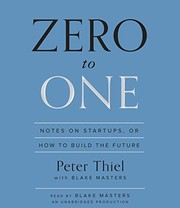 Zero to OneRecommended
by Peter Thiel and Blake Masters
“David Senra revisits Peter Thiel and Blake Masters' Zero to One, examining how founders build creative monopolies by thinking from first principles, starting in deliberately small markets, sequencing expansion strategically, and prioritizing durability over short-term growth metrics across a decade-plus time horizon.”
More from The Founders Podcast
We summarize every new episode. Want them in your inbox?
Similar Episodes
Related episodes from other podcasts

David Senra
May 10
Dana White, UFC

We Study Billionaires
Jan 23
TIP786: Zero to One by Peter Thiel

The James Altucher Show
Dec 21
Why Peter Thiel’s Founder Rules Keep Paying Off

How to Take Over the World
Oct 31
Zero to One
David Senra
Oct 4
How Mark Zuckerberg, Palmer Luckey, Josh Kushner & Scott Wu Think | Jeremy Stern
Explore Related Topics
This podcast is featured in Best Business Podcasts (2026) — ranked and reviewed with AI summaries.
Read this week's Startups & Product Podcast Insights — cross-podcast analysis updated weekly.
You're clearly into The Founders Podcast.
Every Monday, we deliver AI summaries of the latest episodes from The Founders Podcast and 192+ other podcasts. Free for one show.
Start My Monday DigestNo credit card · Unsubscribe anytime