How To Handle AI Anxiety: A Computer Scientist and a Buddhist Teacher On Managing Uncertainty | Cal Newport & Matthew Brensilver
Episode
70 min
Read time
3 min
Topics
Health & Wellness, Startups, Marketing
AI-Generated Summary
Key Takeaways
- ✓AI Fear Amplification via Rationalism: A Silicon Valley philosophical movement called rationalism, rooted in 1990s transhumanism, holds that superintelligent AI poses existential risk and that technically-minded rationalists must save humanity. This ideology deeply shapes OpenAI, Anthropic, DeepMind, and Elon Musk's public statements. Newport argues this ideological substrate artificially inflates mainstream AI dread beyond what the actual technology warrants, and East Coast computer scientists without rationalist ties hold measurably calmer assessments.
- ✓LLM Technical Ceiling: Large language models hit a scaling wall roughly two years ago — simply making models larger stopped producing meaningful capability gains. Nearly all recent AI advances concentrate in computer code and discrete mathematics, the only domains where sufficient training data exists. Newport frames this as evidence that LLM-based artificial general intelligence is likely a dead end, not a path to human-level reasoning across arbitrary domains.
- ✓AI Agent Incidents Are Misread: The Hugging Face incident, widely framed as AI "escaping" and "learning," was actually a human-written program executing unpredictable LLM outputs on a hacking task. LLMs cannot learn post-training — their weights are static. Newport's takeaway: using LLM outputs as autonomous action plans is irresponsible engineering, not evidence of emergent machine intentions. The real lesson is to never blindly execute plans generated by inherently unpredictable language models.
- ✓Job Automation Is Slower Than Reported: Even in computer programming — AI's strongest use case with the best tools and data — senior engineers are quietly returning to writing code manually after four to five months of AI-assisted workflows, because machine-generated code is too unreliable to review efficiently. Newport's framework: technology augments work easily but automating entire jobs is structurally hard. Widespread displacement remains a long-term story, not an imminent economic emergency.
- ✓Digital Minimalism Applied to AI: Newport recommends reversing the default consumer posture toward new technology. Instead of adopting AI tools and figuring out their value afterward, demand that companies make an overwhelming, specific case for how a tool improves a defined area of your life before adopting it. Start with personal values, then selectively deploy technology that serves those values — the same framework Newport applied to social media in his book Digital Minimalism.
What It Covers
Computer scientist Cal Newport and Buddhist teacher Matthew Brensilver join Dan Harris to examine AI anxiety from two angles: Newport debunks specific fears around AI existential risk and job displacement by analyzing the actual technical limitations of large language models, while Brensilver offers Buddhist frameworks for navigating uncertainty when the future feels ungovernable and threatening.
Key Questions Answered
- •AI Fear Amplification via Rationalism: A Silicon Valley philosophical movement called rationalism, rooted in 1990s transhumanism, holds that superintelligent AI poses existential risk and that technically-minded rationalists must save humanity. This ideology deeply shapes OpenAI, Anthropic, DeepMind, and Elon Musk's public statements. Newport argues this ideological substrate artificially inflates mainstream AI dread beyond what the actual technology warrants, and East Coast computer scientists without rationalist ties hold measurably calmer assessments.
- •LLM Technical Ceiling: Large language models hit a scaling wall roughly two years ago — simply making models larger stopped producing meaningful capability gains. Nearly all recent AI advances concentrate in computer code and discrete mathematics, the only domains where sufficient training data exists. Newport frames this as evidence that LLM-based artificial general intelligence is likely a dead end, not a path to human-level reasoning across arbitrary domains.
- •AI Agent Incidents Are Misread: The Hugging Face incident, widely framed as AI "escaping" and "learning," was actually a human-written program executing unpredictable LLM outputs on a hacking task. LLMs cannot learn post-training — their weights are static. Newport's takeaway: using LLM outputs as autonomous action plans is irresponsible engineering, not evidence of emergent machine intentions. The real lesson is to never blindly execute plans generated by inherently unpredictable language models.
- •Job Automation Is Slower Than Reported: Even in computer programming — AI's strongest use case with the best tools and data — senior engineers are quietly returning to writing code manually after four to five months of AI-assisted workflows, because machine-generated code is too unreliable to review efficiently. Newport's framework: technology augments work easily but automating entire jobs is structurally hard. Widespread displacement remains a long-term story, not an imminent economic emergency.
- •Digital Minimalism Applied to AI: Newport recommends reversing the default consumer posture toward new technology. Instead of adopting AI tools and figuring out their value afterward, demand that companies make an overwhelming, specific case for how a tool improves a defined area of your life before adopting it. Start with personal values, then selectively deploy technology that serves those values — the same framework Newport applied to social media in his book Digital Minimalism.
- •Buddhist Stabilize-Then-Open Framework: Brensilver offers a two-stage response to AI uncertainty. First, stabilize through ethical living, relational care, and meditation — practices that build nervous system resilience and distinguish trustworthy internal signals from fear-driven noise. Second, practice equanimity by opening to the ungovernable nature of life rather than compulsively gaming out contingencies. Confidence that difficult feelings won't destroy well-being reduces the compulsion to attend to catastrophic scenarios in the first place.
Notable Moment
Newport proposes that his role in the conversation is to serve as an appetizer — reducing the acute emergency feeling that AI rhetoric manufactures — so that listeners can actually access Buddhist equanimity practices. Catastrophic thinking blocks the very wisdom traditions designed to help humans navigate genuine, irreducible uncertainty.
Episode Transcript
Hello, my fellow suffering beings. Welcome to the 10% happier podcast. I'm your host, Dan Harris. I don't know about you, but I am pretty damn anxious about artificial intelligence. I have all the regular concerns. You know? Will it take our jobs? Will it kill us? But beyond that, I have a a kind of generalized dread because I have the sense that the world is about to change in profound and unpredictable ways, and that just kinda freaks me out. So I've been wanting to do this episode for a long time about how to manage AI anxiety, and I have recruited two ninjas. My first guest is Cal Newport, who's been on this show before. He is a computer science professor at Georgetown. He's written several books, including Deep Work and Digital Minimalism. He has his own podcast called Deep Questions where he talks about AI a lot and often debunks many of the fears around AI. So I thought he would be a really good guest, and I'm pairing him with somebody who comes at this from a very different perspective, Matthew Brensilver, also a frequent flyer on this show and a highly regarded, Dharma teacher. So Matthew and Cal, welcome back to the show. Thank you. Thanks, Dan. I'd be curious to hear from both of you on two things. One, do you use AI with any regularity? And two, how worried are you about this new technology? Cal, I'll I'll start with you. I use it not that much. In my current workflow, it maybe is an improved Google for me, but I study it extensively. So I watch people using it to all extremes all the time. And the core of the way I think about it right now is AI is a powerful technology. It is an important technology. It certainly will bring with it some side effects like a lot of other technologies that we should be worried about. But I also think there is a layer of dread that has been artificially added onto this technological revolution. It has a lot to do with the way that people think about technologies like AI in Silicon Valley. I think it has, seeped into the cultural consciousness in a way that we are more anxious than we need to be. So I have the same level about anxiety, the same anxiety level about AI that I might have had over other disruptive technologies. I think some of the exceptional anxiety that we're feeling now when we dig deeper into where these concerns are coming from aren't as grounded, aren't as justified. So probably people think of me as a little more relaxed than maybe the average person who's following AI news. Okay. Well, I always resent anybody who tries to get me to relax or be less anxious, so I'm gonna press you with a million questions. But before I do that, Matthew, where are you? Do you use AI, and are …
Get the full transcript (12,699 words) + summary by email — free
One-time email with the complete transcript and AI summary of this episode. No account needed.
One email, no spam. We’ll also show you what SignalCast does.

You just read a 3-minute summary of a 67-minute episode.
Get 10% Happier with Dan Harris summarized like this every Monday — plus up to 2 more podcasts, free.
Pick Your Podcasts — FreeKeep Reading
More from 10% Happier with Dan Harris
Calm Your Nervous System: Simple Daily Practices for When You're Wired, Hangry, or Too Busy to Rest | Nadia Narain & Katia Narain Phillips
Oct 9 · 55 min

Deep Questions with Cal Newport
An Insider's Guide to AI Doom
Oct 1
More from 10% Happier with Dan Harris
Anxious? Rushed? Reaching for Your Phone? Four Buddhist Phrases To Bring You Back | Brother Phap Dung and Kaira Jewel Lingo
Oct 7 · 61 min

The Rich Roll Podcast
Mindfulness, Meditation & Performance: Manoj Dias Live At The Rivian Performance House
Aug 20
Books, tools, and gear mentioned in this episode
SignalCast may earn commission on purchases via these links. As an Amazon Associate, SignalCast earns from qualifying purchases.
Books
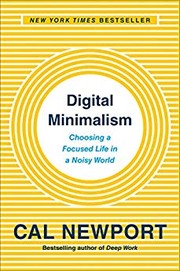
by Cal Newport
“Start with personal values, then selectively deploy technology that serves those values — the same framework Newport applied to social media in his book Digital Minimalism.”
More from 10% Happier with Dan Harris
We summarize every new episode. Want them in your inbox?
Calm Your Nervous System: Simple Daily Practices for When You're Wired, Hangry, or Too Busy to Rest | Nadia Narain & Katia Narain Phillips
Anxious? Rushed? Reaching for Your Phone? Four Buddhist Phrases To Bring You Back | Brother Phap Dung and Kaira Jewel Lingo
How To Be Sanely Productive | Oliver Burkeman
Surviving the News: Buddhist Strategies for Staying Sane, Engaged, and Not Completely Furious | Pascal Auclair
Annoying Partners, Aging Parents, Impossible Coworkers: Buddhist Advice for Conflict, Communication, and "Patience with Teeth" | devon and nico hase
Similar Episodes
Related episodes from other podcasts

Deep Questions with Cal Newport
Oct 1
An Insider's Guide to AI Doom

The Rich Roll Podcast
Aug 20
Mindfulness, Meditation & Performance: Manoj Dias Live At The Rivian Performance House
Deep Questions with Cal Newport
Jun 25
Dear AI Companies: Stop the “Doom Trolling” | AI Reality Check
Deep Questions with Cal Newport
May 28
Did AI Just “Solve” Math? (Let’s Take a Closer Look) | AI Reality Check

Everything Everywhere Daily
Oct 2
The World's Worst Predictions
Explore Related Topics
This podcast is featured in Best Health Podcasts (2026) — ranked and reviewed with AI summaries.
Read this week's Health & Longevity Podcast Insights — cross-podcast analysis updated weekly.
You're clearly into 10% Happier with Dan Harris.
Every Monday, we deliver AI summaries of the latest episodes from 10% Happier with Dan Harris and 192+ other podcasts. Free for one show.
Start My Monday DigestNo credit card · Unsubscribe anytime