OB

Oliver Burkeman

3episodes
3podcasts

Featured On 3 Podcasts

All Appearances

3 episodes

AI Summary

→ WHAT IT COVERS Oliver Burkeman joins Chris Williamson to examine why high achievers systematically convert success into minimum acceptable standards, how the "insecure overachiever" pattern drives productivity addiction, why control-seeking undermines actual performance, and how finite humans can pursue ambitious goals without tying self-worth to outcomes — drawing on Krishnamurti, Jungian psychology, and Burkeman's own midlife transition. → KEY INSIGHTS - **Insecure Overachiever Pattern:** High achievers driven by a need to "fix" an internal void operate in a perpetual deficit state where every accomplishment instantly becomes the new minimum standard. Burkeman identifies this as the core mechanism behind productivity addiction — success produces only relief, never joy. The diagnostic question: when things go well, does your dominant sensation feel like celebration or the abatement of fear? That distinction reveals whether you're creating or fleeing. - **Control vs. Flow Performance:** Attempting to consciously manage performance in real time — what Burkeman calls the "controlly" mode — produces worse outcomes than releasing into the activity. Elite performers across writing, speaking, and sports more frequently operate in flow states where self-monitoring is suspended. The practical implication: when output quality drops, the instinct to grip harder is counterproductive. Deliberately loosening conscious oversight tends to restore performance faster than increased vigilance. - **Finitude as Liberation:** Because every human life ends with unfinished tasks, unanswered emails, and unmet goals, failure is the structural baseline — not an avoidable outcome. Burkeman argues that recognizing this removes the psychological burden of "staving off the great failure." Accepting that the plane has already crashed, metaphorically, redirects energy from defensive maneuvering toward engaged participation in whatever is actually in front of you right now. - **Interest as Productivity Engine:** Burkeman's most counterintuitive productivity finding is that navigating work by what genuinely interests you in a given moment outperforms rigid task scheduling. Insecure overachievers distrust this because they fear they'll collapse without external structure. In practice, people oriented toward achievement find that obligation-based tasks — admin, commitments, correspondence — naturally become appealing at certain points in the day without forcing, making interest-led scheduling a net-positive system. - **Frankl's Inverse Law:** While Viktor Frankl observed that people lacking meaning seek pleasure as distraction, a distinct cohort operates in reverse — those for whom joy, ease, and playfulness are difficult to access default to perpetual hard work because meaning-through-effort is more reliably available than moment-to-moment happiness. This group becomes expert at delayed gratification but systematically deprioritizes present enjoyment, producing outward success alongside chronic subjective dissatisfaction that conventional "work harder" advice actively worsens. - **Advice Hyper-Responders and Selection Bias:** The people most drawn to high-intensity productivity content are precisely those who already over-apply that approach and need the opposite message. Simultaneously, people who need more discipline consume relaxation content. This creates a systematic mismatch where self-improvement media amplifies existing tendencies rather than correcting deficits. Burkeman notes this mirrors a broader pattern: the most susceptible audience for any message is the one for whom that message is least appropriate. - **Settling as Structural Reality:** Commitment-avoidance operates on the false premise that keeping options open avoids trade-offs. Burkeman reframes settling not as a choice but as an inescapable feature of finite existence — every path, including deliberate non-commitment, carries its own costs and foregone benefits. Recognizing that the alternative to committing is not freedom but a different set of losses removes the fantasy of a cost-free option and makes actual decision-making clearer and less emotionally loaded. → NOTABLE MOMENT Burkeman describes a period lasting weeks where he was completely unable to work and felt directionless — symptoms resembling depression but better understood as the gap between an old operating system falling away and a new one not yet formed. He argues this disorienting incongruence phase is structurally necessary during any genuine personal evolution, not a malfunction. 💼 SPONSORS [{"name": "Timeline", "url": "https://timeline.com/modernwisdom"}, {"name": "Athletic Brewing Co", "url": "https://athleticbrewing.com/modernwisdom"}, {"name": "Eight Sleep", "url": "https://8sleep.com/modernwisdom"}, {"name": "LMNT", "url": "https://drinklmnt.com/modernwisdom"}] 🏷️ Productivity Psychology, Insecure Overachievement, Goal Setting, Flow State, Existential Philosophy, Self-Worth, Midlife Transition

AI Summary

→ WHAT IT COVERS Oliver Burkeman discusses how modern productivity culture creates anxiety through impossible expectations, advocating instead for accepting human limitations, embracing imperfection, and finding meaning through present-moment engagement rather than future-focused achievement. → KEY INSIGHTS - **Productivity Debt Mindset:** Most people operate from a baseline feeling they must accomplish enormous amounts just to feel adequate, creating chronic anxiety. This stems from treating productivity as moral worth rather than recognizing finite human capacity always leaves tasks undone. - **Daily-ish Practice Framework:** Commit to habits on a flexible schedule rather than rigid streaks. Doing something four to six times weekly counts as daily-ish, building resilience against the all-or-nothing thinking that causes people to abandon habits entirely after missing one day. - **Decision-Making Over Planning:** When stuck on projects, actively seek small concrete decisions to make rather than endlessly planning. Choosing between three chapter openings or selecting a publishing platform creates forward momentum by closing off alternatives and committing to imperfect action. - **Done Lists vs To-Do Lists:** Track completed tasks instead of pending ones to build self-efficacy. Include basic accomplishments during low motivation periods. This shifts focus from infinite remaining work to tangible evidence of agency, generating energy rather than draining it through comparison to impossibility. - **Future Self Trap:** Stop deferring satisfaction to an idealized future version of yourself who will finally have everything under control. Present moments constitute actual life, not preparation for it. This acceptance enables meaningful engagement now rather than perpetual postponement of fulfillment. → NOTABLE MOMENT Burkeman shares how a family crisis forced him to abandon book-writing plans to help place his mother in memory care. Rather than resenting the disruption, accepting what life demanded in that moment created profound meaning, demonstrating how surrendering control often reveals true priorities. 💼 SPONSORS [{"name": "BetterHelp", "url": "betterhelp.com/richroll"}, {"name": "Whoop", "url": "join.whoop.com/roll"}, {"name": "Momentous", "url": "livemomentous.com"}, {"name": "On", "url": null}, {"name": "Seed", "url": "seed.com/richroll"}, {"name": "Birch", "url": "birchliving.com/richroll"}, {"name": "Squarespace", "url": "squarespace.com/richroll"}] 🏷️ Time Management, Productivity Philosophy, Perfectionism, Acceptance Practice, Creative Process, Work-Life Balance

AI Summary

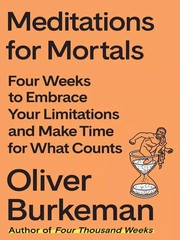
→ WHAT IT COVERS Oliver Burkeman discusses his book Meditations for Mortals, exploring how accepting human limitations liberates action, why urgency often misleads us, and how mortality awareness should slow us down rather than speed us up. → KEY INSIGHTS - **Finitude as liberation:** Accepting you cannot do everything eliminates the impossible standard of controlling infinity. This perspective shift reduces anxiety because you stop fighting an unwinnable battle against your natural human limitations and finite time. - **Urgency misconception:** Speed reading, rushing through activities, and forcing urgency often backfire. Pleasurable activities like reading, eating, or time with children should be savored, not accelerated. The destination of rushing is ultimately death, making haste counterproductive to living well. - **Attention economy trap:** Knowing about global problems and feeling bad does not equal helping solve them. Set up recurring donations or take concrete action instead of mainlining suffering through social media, which polarizes everyone while accomplishing nothing meaningful. - **Intuitive productivity:** Rigid time-blocking systems create anxiety through constant reminders of undone tasks. Choose one thing in each moment, complete it, then choose another. Writing works best mornings, but making this a strict rule steals spontaneity and creates unnecessary tension. → NOTABLE MOMENT Burkeman describes philosopher Simone Weil weeping in a park over distant violence in Crimea, illustrating how people flatten themselves by absorbing worldwide suffering without contributing solutions, a pattern amplified exponentially by modern social media algorithms. 💼 SPONSORS [{"name": "GiveWell", "url": "givewell.org"}, {"name": "Whole Foods Market", "url": null}, {"name": "Fundrise", "url": "fundrise.com/dailystoke"}, {"name": "Helix Sleep", "url": "helixsleep.com/stoic"}, {"name": "Momentous", "url": "livemomentous.com"}, {"name": "Humann", "url": "humann.com/stoic"}] 🏷️ Time Management, Mortality Awareness, Productivity Systems, Stoic Philosophy

Explore More

Never miss Oliver Burkeman's insights

Subscribe to get AI-powered summaries of Oliver Burkeman's podcast appearances delivered to your inbox weekly.

Start Free Today

No credit card required • Free tier available