The Lie That Keeps You Feeling Behind Every Single Day | Oliver Burkeman
Episode
58 min
Read time
2 min
Topics
Productivity, Health & Wellness, Fundraising & VC
AI-Generated Summary
Key Takeaways
- ✓Finitude as liberation: Accepting you cannot do everything eliminates the impossible standard of controlling infinity. This perspective shift reduces anxiety because you stop fighting an unwinnable battle against your natural human limitations and finite time.
- ✓Urgency misconception: Speed reading, rushing through activities, and forcing urgency often backfire. Pleasurable activities like reading, eating, or time with children should be savored, not accelerated. The destination of rushing is ultimately death, making haste counterproductive to living well.
- ✓Attention economy trap: Knowing about global problems and feeling bad does not equal helping solve them. Set up recurring donations or take concrete action instead of mainlining suffering through social media, which polarizes everyone while accomplishing nothing meaningful.
- ✓Intuitive productivity: Rigid time-blocking systems create anxiety through constant reminders of undone tasks. Choose one thing in each moment, complete it, then choose another. Writing works best mornings, but making this a strict rule steals spontaneity and creates unnecessary tension.
What It Covers
Oliver Burkeman discusses his book Meditations for Mortals, exploring how accepting human limitations liberates action, why urgency often misleads us, and how mortality awareness should slow us down rather than speed us up.
Key Questions Answered
- •Finitude as liberation: Accepting you cannot do everything eliminates the impossible standard of controlling infinity. This perspective shift reduces anxiety because you stop fighting an unwinnable battle against your natural human limitations and finite time.
- •Urgency misconception: Speed reading, rushing through activities, and forcing urgency often backfire. Pleasurable activities like reading, eating, or time with children should be savored, not accelerated. The destination of rushing is ultimately death, making haste counterproductive to living well.
- •Attention economy trap: Knowing about global problems and feeling bad does not equal helping solve them. Set up recurring donations or take concrete action instead of mainlining suffering through social media, which polarizes everyone while accomplishing nothing meaningful.
- •Intuitive productivity: Rigid time-blocking systems create anxiety through constant reminders of undone tasks. Choose one thing in each moment, complete it, then choose another. Writing works best mornings, but making this a strict rule steals spontaneity and creates unnecessary tension.
Notable Moment
Burkeman describes philosopher Simone Weil weeping in a park over distant violence in Crimea, illustrating how people flatten themselves by absorbing worldwide suffering without contributing solutions, a pattern amplified exponentially by modern social media algorithms.
Episode Transcript
One of the things I try to do towards the end of the year, it's something my parents taught me, is, like, things slow down, you finally can think about things for a minute. I wanna pick something or someone to be consciously generous to. When we're out we're traveling on Christmas day, I love to tip big. But one of the things I love to do with my family is we pull up GiveWell, and we find a highly effective charity, and we donate money to it. Right? Sometimes when you're doing charitable donations, like, does it help? Does it make a difference? You donate to this fund or that fund. But one of the things that's so empowering about GiveWell is they put a number on the effectiveness. Right? You know that it's making a difference, which is why over a 150,000 donors have already trusted GiveWell to give more than 2 and a half billion dollars, and rigorous evidence suggests that these donations will save over 300,000 lives and improve the lives of millions more, which is why when I'm thinking about making a charitable donation, I check GiveWell first. You can find all their research and recommendations on their site for free. And thanks to the donors that sponsor that research, GiveWell doesn't take a cut of your tax deductible donation when you give it to one of the recommended funds. This is your first gift through GiveWell. You can have your donation matched up to $100 before the end of the year or as long as matching funds last. And to claim your match, you just go to givewell.org and pick podcast, and enter The Daily Stoic at checkout. Make sure they know you heard about GiveWell from The Daily Stoic to get your donation matched. Givewell.org, code The Daily Stoic to donate or find out more. So on Monday, I had a talk. I was flying to Florida for a talk, but I took the kids to school. I worked at the office, and then I picked them up from school. We went to Whole Foods, did our weekly grocery shopping as, the boys and I do every week, and then I drove. We met at a parking lot near the airport. I handed my wife the kids and all the groceries, and then I flew to Florida, flew home. And then, when I got back the next night, I made myself a sandwich from the groceries that I had just bought. And actually, the week before, I I took them to Whole Foods for a weekly thing, and I had a phone call I had to do. They played upstairs on the, on the playground. The the Whole Foods headquarters here in Austin has a second story playground. They played on that while I did my phone call, and then together, we went and did all our grocery shopping. I love Whole Foods. I don't have to worry about what I'm feeding my …
Get the full transcript (13,414 words) + summary by email — free
One-time email with the complete transcript and AI summary of this episode. No account needed.
One email, no spam. We’ll also show you what SignalCast does.

You just read a 3-minute summary of a 55-minute episode.
Get The Daily Stoic summarized like this every Monday — plus up to 2 more podcasts, free.
Pick Your Podcasts — FreeKeep Reading
More from The Daily Stoic
This is the Main Thing | Ask Daily Stoic
Apr 2 · 13 min

10% Happier with Dan Harris
How To Be Sanely Productive | Oliver Burkeman
Oct 5
More from The Daily Stoic
BONUS | Books You Can Finish In One Sitting (And Actually Remember)
Apr 1 · 8 min

The Rich Roll Podcast
The Productivity Myth: Oliver Burkeman On Our Broken Relationship With Time, Embracing Our Limitations & Why More Isn’t Always Better
Nov 24
Books, tools, and gear mentioned in this episode
SignalCast may earn commission on purchases via these links. As an Amazon Associate, SignalCast earns from qualifying purchases.
Books
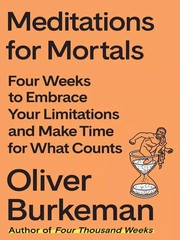
by Oliver Burkeman
“Oliver Burkeman discusses his book Meditations for Mortals, exploring how accepting human limitations liberates action, why urgency often misleads us, and how mortality awareness should slow us down rather than speed us up.”
More from The Daily Stoic
We summarize every new episode. Want them in your inbox?
This is the Main Thing | Ask Daily Stoic
BONUS | Books You Can Finish In One Sitting (And Actually Remember)
How Can This Improve Your Life? | The Color of Your Thoughts
The Perspective Shift I Had in Australia (A Stoic Lesson)
Live Now, While You Still Can
Similar Episodes
Related episodes from other podcasts

10% Happier with Dan Harris
Oct 5
How To Be Sanely Productive | Oliver Burkeman

The Rich Roll Podcast
Nov 24
The Productivity Myth: Oliver Burkeman On Our Broken Relationship With Time, Embracing Our Limitations & Why More Isn’t Always Better

Modern Wisdom
Feb 19
#1061 - Oliver Burkeman - Why You Can’t Stop Your Productivity Addiction

Unchained
Feb 7
When AI Agents Take Over, What Does a Post-Human Economy Look Like?

Deep Questions with Cal Newport
Dec 15
Ep 383: Why Is Everyone Talking About “Against the Machine”? (w/ Tyler Austin Harper)
Explore Related Topics
This podcast is featured in Best Philosophy Podcasts (2026) — ranked and reviewed with AI summaries.
Read this week's Health & Longevity Podcast Insights — cross-podcast analysis updated weekly.
You're clearly into The Daily Stoic.
Every Monday, we deliver AI summaries of the latest episodes from The Daily Stoic and 192+ other podcasts. Free for one show.
Start My Monday DigestNo credit card · Unsubscribe anytime