Episode 315: Ceaseless Striving (Schopenhauer's Pessimism)
Episode
90 min
Read time
2 min
Topics
Career Growth, Productivity, Relationships
AI-Generated Summary
Key Takeaways
- ✓Suffering as Default State: Schopenhauer reverses Leibniz's view that evil is merely absence of good, arguing suffering is the constant baseline of existence while pleasure is only temporary relief from pain before new desires emerge, making happiness inherently fleeting and disappointing compared to the enduring nature of misery and want.
- ✓Boredom as Existential Proof: When basic needs are satisfied, humans face crippling boredom that drives them to create wars, conflicts, or increasingly elaborate desires. This demonstrates existence itself lacks intrinsic value since merely being alive without striving produces unbearable emptiness, unlike animals who live contentedly in the present moment.
- ✓Reason as Double-Edged Sword: Human cognitive abilities enable aesthetic appreciation and hope but also create unique suffering through anticipation of future disappointments, regret about the past, and ability to sum up lifetime dissatisfaction. Animals avoid this meta-level suffering by remaining present-focused, making them paradoxically better off despite less complex experiences.
- ✓Professional Achievement Paradox: Career success consistently fails to deliver expected happiness because the striving itself provides motivation's fuel. Once goals are achieved, people feel empty and immediately fixate on next milestones rather than experiencing satisfaction, explaining why highly successful individuals often remain as unhappy as before their accomplishments.
- ✓Compassion Through Shared Suffering: Schopenhauer derives ethics not from happiness but from recognizing all humans as fellow sufferers driven by blind, aimless will. This perspective demands tolerance, patience, and love toward others' faults since everyone shares the same fundamental struggle, making "my fellow sufferer" the most honest form of address between people.
What It Covers
Tamler Sommers and David Pizarro examine Arthur Schopenhauer's pessimistic philosophy through his 1850 essays "On the Sufferings of the World" and "On the Vanity of Existence," exploring his views on suffering, boredom, and human existence.
Key Questions Answered
- •Suffering as Default State: Schopenhauer reverses Leibniz's view that evil is merely absence of good, arguing suffering is the constant baseline of existence while pleasure is only temporary relief from pain before new desires emerge, making happiness inherently fleeting and disappointing compared to the enduring nature of misery and want.
- •Boredom as Existential Proof: When basic needs are satisfied, humans face crippling boredom that drives them to create wars, conflicts, or increasingly elaborate desires. This demonstrates existence itself lacks intrinsic value since merely being alive without striving produces unbearable emptiness, unlike animals who live contentedly in the present moment.
- •Reason as Double-Edged Sword: Human cognitive abilities enable aesthetic appreciation and hope but also create unique suffering through anticipation of future disappointments, regret about the past, and ability to sum up lifetime dissatisfaction. Animals avoid this meta-level suffering by remaining present-focused, making them paradoxically better off despite less complex experiences.
- •Professional Achievement Paradox: Career success consistently fails to deliver expected happiness because the striving itself provides motivation's fuel. Once goals are achieved, people feel empty and immediately fixate on next milestones rather than experiencing satisfaction, explaining why highly successful individuals often remain as unhappy as before their accomplishments.
- •Compassion Through Shared Suffering: Schopenhauer derives ethics not from happiness but from recognizing all humans as fellow sufferers driven by blind, aimless will. This perspective demands tolerance, patience, and love toward others' faults since everyone shares the same fundamental struggle, making "my fellow sufferer" the most honest form of address between people.
Notable Moment
Schopenhauer argues that comparing the pleasure of an animal eating versus the terror of the animal being eaten demonstrates pain's dominance over pleasure in existence. This rhetorical device, while somewhat unfair, powerfully illustrates his core claim that suffering fundamentally outweighs joy in the natural world's design.
Episode Transcript
Very Bad Wizards is a podcast with a philosopher, my dad, and psychologist, Dave Fesaro, having an informal discussion about issues in science and ethics. Please note that the discussion contains bad words that I'm not allowed to say, and knowing my dad, some very inappropriate jokes. Maiden art has spoken. The lady, Hans, has spoken. Pay no attention to that man behind the curtain. Who are you? Who are you? You? A very bad man. I'm a very good man. Good man. They think they've lost, and with no more brains than you laps. Pay no attention to that bitch. Anybody can have a brain. You're a very bad man. I'm a very good man. Just a very bad wizard. Welcome to Very Bad Wizards. I'm Tamler Summers from the University of Houston. Dave, yesterday was my birthday. I turned 55, which is ridiculous and unacceptable on every level. Speaking of birthdays, yours is coming up soon too. How old are you gonna be? I'm in my forties currently, so I don't know what what I was gonna be nice to you and not bring up the actual age that you turned because I I knew that I it. It's a terrible age, actually. I was thinking, like, 56 is better than 55. I feel like 56 is, like, a honest age. Like, it's like a strong age to be, but 55 just is old and shitty. I'm I'm turning the big five o in September. Mhmm. I'm having trouble dealing with it. Are you doing anything? Like, having a party? Probably probably not anything big. I was invited by a dear friend of mine to travel to go to a rap concert, but but it feels kind of like I don't wanna leave my kids, you know, like, on the actual day of Yeah. But I'll figure something out. My life is boring, man. Hopefully, I do something. I'll, like, have two and a half drinks and maybe watch a movie. Well, you're you're embracing what it means to be a 50 year old, I guess. Alright. Happy birthday, by the way. Thank you. And, I will transition us right into this because I was thinking of this, in fact, as kind of something for your birthday to do in the intro segment. But before we get to that, do you wanna say what we're talking about? Yeah. With record speed, we are doing an episode that was voted on by our beloved Patreon supporters on Arthur Schopenhauer and in particular, these two essays in his studies on pessimism. The first is on the sufferings of the world and then also a very short essay on the vanity of existence. Yeah. So we'll be talking about that. I think it's kind of in our sweet spot of stuff to talk about. Absolutely. And I know what you're talking about record time. We're always so responsive about this stuff. Yeah. Like with Joseph Campbell. Well, I mean, what was …
Get the full transcript (16,033 words) + summary by email — free
One-time email with the complete transcript and AI summary of this episode. No account needed.
One email, no spam. We’ll also show you what SignalCast does.

You just read a 3-minute summary of a 87-minute episode.
Get Very Bad Wizards summarized like this every Monday — plus up to 2 more podcasts, free.
Pick Your Podcasts — FreeKeep Reading


Books, tools, and gear mentioned in this episode
SignalCast may earn commission on purchases via these links. As an Amazon Associate, SignalCast earns from qualifying purchases.
Books
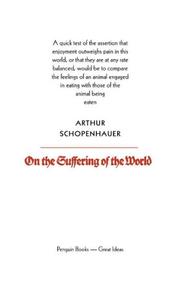 On the Sufferings of the WorldBy guest
by Arthur Schopenhauer
“Tamler Sommers and David Pizarro examine Arthur Schopenhauer's pessimistic philosophy through his 1850 essays "On the Sufferings of the World" and "On the Vanity of Existence"”
 On the Vanity of ExistenceBy guest
by Arthur Schopenhauer
“Tamler Sommers and David Pizarro examine Arthur Schopenhauer's pessimistic philosophy through his 1850 essays "On the Sufferings of the World" and "On the Vanity of Existence"”
More from Very Bad Wizards
We summarize every new episode. Want them in your inbox?
Episode 329: Why We Suffer
Episode 328: Weapons Free
Episode 327: You Ain't So Smart (Flannery O'Connor's "Good Country People")
Episode 326: The Most Important Episode of Your (Academic) Life
Episode 325: It Is Happening Again
Similar Episodes
Related episodes from other podcasts

Acquired
Oct 19
Seinfeld

David Senra
Oct 14
Lessons from Napoleon, Steve Jobs, Joan of Arc & Other Leaders | Ben Wilson

The Vergecast
Oct 9
The AI is in the computer

The Founders Podcast
Oct 5
#436 Ari Emanuel's Autobiography

a16z Podcast
Oct 4
David George & Jack Altman on AI, Autonomy, and the Next $25 Trillion
Explore Related Topics
This podcast is featured in Best Philosophy Podcasts (2026) — ranked and reviewed with AI summaries.
You're clearly into Very Bad Wizards.
Every Monday, we deliver AI summaries of the latest episodes from Very Bad Wizards and 192+ other podcasts. Free for one show.
Start My Monday DigestNo credit card · Unsubscribe anytime