James Robinson on What It Looks Like When a State is Failing
Episode
37 min
Read time
2 min
Topics
Health & Wellness, Startups, Software Development
AI-Generated Summary
Key Takeaways
- ✓Inclusive vs. Extractive Institutions: Robinson's core framework distinguishes societies that create broad-based economic opportunity from those that concentrate benefits among narrow elites. Venezuela's collapse under Chavismo exemplifies extractive institutions, while early Virginia's shift to universal male suffrage — driven by the need to attract settlers after indigenous exploitation failed — demonstrates how inclusive institutions emerge from practical necessity rather than ideology.
- ✓U.S. Inclusion Failure: Americans without college degrees, representing a narrow majority of the population, earn no more today than they did 50 years ago. Robinson frames this stagnation as a measurable inclusion failure, driven by computer-driven displacement and de-unionization, and argues Trump's political rise is a symptom of this structural problem rather than its cause.
- ✓China's Extractive Growth Ceiling: China's post-1978 growth stems from the Communist Party deliberately detaching itself from the economy to permit entrepreneurship, not from political reform. Robinson classifies this as "extractive growth" — the same pattern seen in the Soviet Union's 50-year expansion — and predicts it will eventually derail because concentrated political power corrupts and blocks necessary creative destruction.
- ✓Unions as Political Infrastructure: Economists who advocate eliminating unions for short-term GDP gains overlook their political function. In Scandinavian countries, unions built and sustained inclusive political institutions over decades. Robinson argues de-unionization in the U.S. contributed directly to the current wave of voter alienation, making the political cost of union decline far larger than standard economic models capture.
- ✓Outside Powers Cannot Fix Extractive States: Research on institutional transitions shows countries move from extractive to inclusive systems through internal political resolution, not external intervention. Chile's emergence as Latin America's strongest economy resulted from Chileans resolving their own political equilibrium in the 1980s. Robinson states the U.S. cannot solve Venezuela's institutional problems, though it could avoid actively worsening them.
What It Covers
Nobel Prize-winning economist James Robinson, author of Why Nations Fail, joins Odd Lots live in Chicago to explain why inclusive versus extractive institutions determine economic outcomes, assess current U.S. institutional health, and predict China's eventual growth slowdown despite its remarkable economic rise since 1978.
Key Questions Answered
- •Inclusive vs. Extractive Institutions: Robinson's core framework distinguishes societies that create broad-based economic opportunity from those that concentrate benefits among narrow elites. Venezuela's collapse under Chavismo exemplifies extractive institutions, while early Virginia's shift to universal male suffrage — driven by the need to attract settlers after indigenous exploitation failed — demonstrates how inclusive institutions emerge from practical necessity rather than ideology.
- •U.S. Inclusion Failure: Americans without college degrees, representing a narrow majority of the population, earn no more today than they did 50 years ago. Robinson frames this stagnation as a measurable inclusion failure, driven by computer-driven displacement and de-unionization, and argues Trump's political rise is a symptom of this structural problem rather than its cause.
- •China's Extractive Growth Ceiling: China's post-1978 growth stems from the Communist Party deliberately detaching itself from the economy to permit entrepreneurship, not from political reform. Robinson classifies this as "extractive growth" — the same pattern seen in the Soviet Union's 50-year expansion — and predicts it will eventually derail because concentrated political power corrupts and blocks necessary creative destruction.
- •Unions as Political Infrastructure: Economists who advocate eliminating unions for short-term GDP gains overlook their political function. In Scandinavian countries, unions built and sustained inclusive political institutions over decades. Robinson argues de-unionization in the U.S. contributed directly to the current wave of voter alienation, making the political cost of union decline far larger than standard economic models capture.
- •Outside Powers Cannot Fix Extractive States: Research on institutional transitions shows countries move from extractive to inclusive systems through internal political resolution, not external intervention. Chile's emergence as Latin America's strongest economy resulted from Chileans resolving their own political equilibrium in the 1980s. Robinson states the U.S. cannot solve Venezuela's institutional problems, though it could avoid actively worsening them.
Notable Moment
Robinson reveals he is using AI to analyze digitized works of 17th-century political philosophy — Hobbes, Locke and contemporaries — to measure how philosophical ideas shaped actual political behavior in British politics, research he says would have been entirely impossible before large language models existed.
Episode Transcript
00:00:02 Speaker 1: Bloomberg Audio Studios. 00:00:04 Speaker 2: Podcasts. Radio. News. 00:00:18 Speaker 3: Hello and welcome to a very special episode of the Odd Lots podcast taped live in Chicago. I'm Tracy Alloway. 00:00:25 Speaker 1: And I'm Joe Weisenthal. 00:00:27 Speaker 3: Joe, there's a lot to talk about when it comes to institutional failures nowadays. 00:00:31 Speaker 4: Yeah, absolutely true. You know, there's a lot of people, they talk about geopolitics a lot. And of course, there's multiple wars going on. But I also think that if you're in the markets these days, Just thinking about the economy, you actually just have to talk about politics, politics. 00:00:45 Speaker 3: You really do. And so I'm very happy to say that we have the perfect guest, someone who's actually never been on the show before. But I think a lot of listeners will have heard of him because not only is he a Nobel Prize winner, he is also the author of a very famous book that you and I have probably read a couple of times now called Why Nations Fail. So we're going to be speaking with James Robinson. He is, of course, a professor at the University of Chicago. Hope you enjoy the conversation. Well, Professor Robinson, thank you so much for joining us. Really appreciate it. 00:01:14 Speaker 2: My pleasure. 00:01:16 Speaker 3: Why do nations fail? 00:01:18 Speaker 2: No. 00:01:19 Speaker 3: OK, let me ask the other obvious question right now. I'm just going to get into it. Is the US a failing nation? 00:01:27 Speaker 2: How long do we have? I know. Okay, good. Not yet. Not yet. Yeah. 00:01:34 Speaker 4: Wait, I have one more random question. Do you call yourself a Nobel Prize winner, or do you say, like, you're a Nobel Prize winner, right? I think it's a real Nobel Prize. 00:01:45 Speaker 2: Well, you know, there's some debate about that. I know. 00:01:47 Speaker 5: Because Alfred Nobel didn't actually specify a prize for. 00:01:51 Speaker 2: Economics, you know, and it came later on. Yeah. So, you know. 00:01:56 Speaker 1: It's a Nobel Prize. You're a Nobel Prize winner. 00:01:58 Speaker 3: I think you should just go for it. 00:01:59 Speaker 2: Yeah. I've got the badge. Oh, there you go. All right. The U.S. 00:02:06 Speaker 3: Is not a failed state or failed nation. 00:02:10 Speaker 1: Is it failing? 00:02:11 Speaker 5: No, I mean, you know, by failure, you know, we're really talking about economic failure, economic success. Failure is a big word. It covers lots of things. So, you know, my work is really about economics and about how society's who succeed economically do so because they create institutions, sets of institutions, kind of rules that channel people's energy in directions which are socially beneficial, innovation, entrepreneurship, creativity. But those energies can be channeled in many different ways. And I think …
Get the full transcript (6,897 words) + summary by email — free
One-time email with the complete transcript and AI summary of this episode. No account needed.
One email, no spam. We’ll also show you what SignalCast does.

You just read a 3-minute summary of a 34-minute episode.
Get Odd Lots summarized like this every Monday — plus up to 2 more podcasts, free.
Pick Your Podcasts — FreeKeep Reading
More from Odd Lots
CME's Terry Duffy on the Disconcerting State of Finance Regulation
Oct 20 · 29 min

Pivot
How Paul Krugman Would Fix The Economy: Solutions with Henry Blodget
Sep 2
More from Odd Lots
Don Wilson on the GPU Market's Trillion Dollar Question
Oct 19 · 26 min

Huberman Lab
What Makes Great Leaders & How to Live an Extraordinary Life | Dr. Jared Diamond
Oct 19
Books, tools, and gear mentioned in this episode
SignalCast may earn commission on purchases via these links. As an Amazon Associate, SignalCast earns from qualifying purchases.
Books
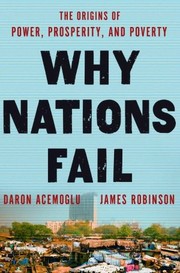 Why Nations FailBy guest
by James Robinson
“Nobel Prize-winning economist James Robinson, author of Why Nations Fail, joins Odd Lots live in Chicago to explain why inclusive versus extractive institutions determine economic outcomes”
More from Odd Lots
We summarize every new episode. Want them in your inbox?
CME's Terry Duffy on the Disconcerting State of Finance Regulation
Don Wilson on the GPU Market's Trillion Dollar Question
David Byrne Explains How Forgotten Ideas Come Back to Life
The French Political Crisis That's Turning Into a Debt Crisis
Jeff Yan's Plan to Bring the Entire Financial Industry Onto Hyperliquid
Similar Episodes
Related episodes from other podcasts

Pivot
Sep 2
How Paul Krugman Would Fix The Economy: Solutions with Henry Blodget

Huberman Lab
Oct 19
What Makes Great Leaders & How to Live an Extraordinary Life | Dr. Jared Diamond

The Peter Attia Drive
Oct 19
#412 ‒ The evolving science of cancer: emerging approaches to prevention and early detection, and the advances reshaping treatment | Siddhartha Mukherjee, M.D., Ph.D.

Everything Everywhere Daily
Sep 8
Organ Transplants

The Joe Rogan Experience
Sep 3
#2549 - Jared Diamond
Explore Related Topics
This podcast is featured in Best Finance Podcasts (2026) — ranked and reviewed with AI summaries.
Read this week's Health & Longevity Podcast Insights — cross-podcast analysis updated weekly.
You're clearly into Odd Lots.
Every Monday, we deliver AI summaries of the latest episodes from Odd Lots and 192+ other podcasts. Free for one show.
Start My Monday DigestNo credit card · Unsubscribe anytime