#1067 - Cal Newport - The collapse of modern attention (and how to get it back)
Episode
105 min
Read time
3 min
Topics
Career Growth, Productivity, Remote Work
AI-Generated Summary
Key Takeaways
- ✓Attention switching cost: The brain requires 10–20 minutes to fully shift focus between abstract cognitive tasks. Interruptions every two minutes — the current Microsoft-measured average across tens of thousands of knowledge workers — mean the brain never locks in, producing a state of diffuse cognitive friction experienced as chronic mental fatigue. The practical fix is not inbox management but restructuring collaboration protocols so ad hoc back-and-forth messaging becomes structurally unnecessary rather than personally resisted.
- ✓Workload as root cause: Newport identifies three compounding problems across his books — focus training, communication protocols, and workload management — but ranks workload control as producing the highest return. Agreeing to more projects generates unavoidable communication overhead for each one. The reward function is nonlinear: past a threshold, adding commitments decreases total output. A default-no policy to new commitments, rather than a triage rule, is the only sustainable approach because triage criteria eventually get overwhelmed.
- ✓Hyperactive hive mind trap: The reason limiting Slack hours fails unilaterally is structural. If a project's progress depends on rapid back-and-forth messaging, every participant must monitor their inbox constantly or the coordination chain breaks. The solution requires changing the collaboration method itself — daily stand-ups to front-load information needs, office hours for non-urgent questions, and explicit protocols for recurring project types — so asynchronous urgency is eliminated by design rather than willpower.
- ✓Work slop and AI: Harvard Business Review research identifies "work slop" — AI-generated emails, reports, and presentations produced quickly but at such low quality they increase everyone else's cognitive burden without advancing actual goals. Newport argues this pattern reveals a pre-existing problem: context-switching exhausts workers' cognitive reserves, AI offers to smooth over the effort peaks, and the output is low-value content that obscures rather than solves underlying productivity dysfunction already present before AI arrived.
- ✓LLM scaling plateau: OpenAI's internal Project Orion and parallel efforts at Anthropic and Meta all failed to replicate the GPT-3-to-GPT-4 performance jump by simply scaling model size and training duration further. Newport argues current AI development has shifted from genuine capability scaling to benchmark optimization through fine-tuning — a fundamentally different and narrower game. Future AI progress will likely come from bespoke hybrid architectures combining language models with explicit world models, policy networks, and logic engines rather than larger frontier models.
What It Covers
Cal Newport marks the 10-year anniversary of Deep Work by examining why workplace distraction has worsened — not improved — since 2016. Microsoft data now shows knowledge workers switch to a communication tool every two minutes, with actual productive work displaced to Saturday and Sunday mornings. Newport connects hyperactive hive-mind collaboration, AI-generated work slop, and atrophied concentration into a unified diagnosis of modern knowledge work failure.
Key Questions Answered
- •Attention switching cost: The brain requires 10–20 minutes to fully shift focus between abstract cognitive tasks. Interruptions every two minutes — the current Microsoft-measured average across tens of thousands of knowledge workers — mean the brain never locks in, producing a state of diffuse cognitive friction experienced as chronic mental fatigue. The practical fix is not inbox management but restructuring collaboration protocols so ad hoc back-and-forth messaging becomes structurally unnecessary rather than personally resisted.
- •Workload as root cause: Newport identifies three compounding problems across his books — focus training, communication protocols, and workload management — but ranks workload control as producing the highest return. Agreeing to more projects generates unavoidable communication overhead for each one. The reward function is nonlinear: past a threshold, adding commitments decreases total output. A default-no policy to new commitments, rather than a triage rule, is the only sustainable approach because triage criteria eventually get overwhelmed.
- •Hyperactive hive mind trap: The reason limiting Slack hours fails unilaterally is structural. If a project's progress depends on rapid back-and-forth messaging, every participant must monitor their inbox constantly or the coordination chain breaks. The solution requires changing the collaboration method itself — daily stand-ups to front-load information needs, office hours for non-urgent questions, and explicit protocols for recurring project types — so asynchronous urgency is eliminated by design rather than willpower.
- •Work slop and AI: Harvard Business Review research identifies "work slop" — AI-generated emails, reports, and presentations produced quickly but at such low quality they increase everyone else's cognitive burden without advancing actual goals. Newport argues this pattern reveals a pre-existing problem: context-switching exhausts workers' cognitive reserves, AI offers to smooth over the effort peaks, and the output is low-value content that obscures rather than solves underlying productivity dysfunction already present before AI arrived.
- •LLM scaling plateau: OpenAI's internal Project Orion and parallel efforts at Anthropic and Meta all failed to replicate the GPT-3-to-GPT-4 performance jump by simply scaling model size and training duration further. Newport argues current AI development has shifted from genuine capability scaling to benchmark optimization through fine-tuning — a fundamentally different and narrower game. Future AI progress will likely come from bespoke hybrid architectures combining language models with explicit world models, policy networks, and logic engines rather than larger frontier models.
- •Cognitive strain as competitive advantage: As AI reduces the cost of producing average-quality knowledge work output, the scarcity premium shifts entirely to people comfortable with sustained cognitive strain. Newport frames this using the weightlifter analogy: the burn signals growth. Deliberately seeking hard thinking sessions, resisting the blank-page avoidance reflex, and building focus as a practiced skill positions workers to produce rare, unambiguously valuable output — the only category that generates durable economic leverage and negotiating power over working conditions.
- •Organizational restructuring protocol: Newport outlines a concrete four-part fix for teams: implement visible workload tracking with a work-in-progress limit of roughly three active projects per person; ban multi-message resolution over digital channels, routing those to daily office hours instead; build explicit written protocols for every recurring collaboration type; and treat deep work hours as a tracked cultural metric discussed in team check-ins. The morning stand-up plus end-of-session accountability pairing is the minimum viable structure to make protected focus time sustainable.
Notable Moment
Newport reveals that Saturday and Sunday mornings are the only times Microsoft's workplace data shows a meaningful spike in actual productivity tool usage — Word, Excel, PowerPoint — because weekdays are consumed entirely by communication. The implication is that organizations are effectively paying five days of salaries to conduct coordination, then relying on unpaid weekend hours to produce the work itself.
Episode Transcript
Dude, you must be feeling like Cassandra at the moment. So prescient, the distraction, the necessity of deep work, the inherent bombardment of our attention. Do you do you feel like you saw the future earlier than what even at the time maybe felt late with deep work and focusing on quality over quantity and stuff? I mean, I think part of what I noticed was the present was crazy to me, and no one else recognized it. So it was less even predicting the future. I I I feel like there was a time, gosh, like ten years ago now, where I was looking around and, yeah, saying two things. One, social media doesn't make sense. Why are we all pretending like this is at the the center of democracy and civic life and all business, and we all have to be on here all the time? And two, email doesn't make sense. Not what was gonna happen in the future. I'm just, like, looking at the way we're working today with email and then Slack and Teams was coming. Like, this completely does not make sense. You're switching your context once every two or three minutes. This is a terrible way to actually use your brain. So I never thought of myself as predicting the future as much as just telling people what was going on then, then it makes sense. And everyone thought I was crazy. And ten years later, it just kinda jumped from I was crazy to its common sense. So it's not even that interesting that I'm saying it anymore. So I kinda skipped the part where Mhmm. Where it sounded prescient. Do you feel vindicated? I think certainly on a couple issues. The social media issue was a big one because I used to get a lot of flack for that, for for going out. And I wasn't even saying the social media was bad or that no one should use it. Really, what I was pushing back on was just the idea of ubiquity, the idea that everyone had to use it. I said, this doesn't make sense. I get there's some people this makes sense for. There's a lot of technologies that have markets that make sense for it. But why is there this pressure for everyone to be on these services? This is not going to a good place. They're they're spending a lot of money to mine attention, and they're gonna get better at it. Right? And at the time, this was considered, crazy. What do you mean, like, you wouldn't use social media? I wrote a New York Times op ed back. I looked this up the other day. It was 2016, and it argued maybe social media is not the biggest thing for a young person to focus on if they're thinking about their career. That's what it was. It was like focus on your career instead of social media. Actually doing things well is what really …
Get the full transcript (21,937 words) + summary by email — free
One-time email with the complete transcript and AI summary of this episode. No account needed.
One email, no spam. We’ll also show you what SignalCast does.

You just read a 3-minute summary of a 102-minute episode.
Get Modern Wisdom summarized like this every Monday — plus up to 2 more podcasts, free.
Pick Your Podcasts — FreeKeep Reading
More from Modern Wisdom
Why You Feel Everything So Deeply (and how to survive it) - Dr Sasha Hamdani - #1147
Sep 7 · 84 min

The Vergecast
How Claude Code Claude Codes
Feb 24
More from Modern Wisdom
Couples Therapist: “The One Rule Every Relationship Must Live By” - Stan Tatkin -#1146
Sep 5 · 69 min

Deep Questions with Cal Newport
Rethinking the Deep Life Stack (Again!) | Monday Advice
Aug 31
Books, tools, and gear mentioned in this episode
SignalCast may earn commission on purchases via these links. As an Amazon Associate, SignalCast earns from qualifying purchases.
Books
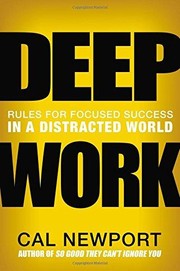 Deep WorkBy guest
by Cal Newport
“Cal Newport marks the 10-year anniversary of Deep Work by examining why workplace distraction has worsened — not improved — since 2016.”
Tools
“The reason limiting Slack hours fails unilaterally is structural. If a project's progress depends on rapid back-and-forth messaging, every participant must monitor their inbox constantly or the coordination chain breaks.”
More from Modern Wisdom
We summarize every new episode. Want them in your inbox?
Why You Feel Everything So Deeply (and how to survive it) - Dr Sasha Hamdani - #1147
Couples Therapist: “The One Rule Every Relationship Must Live By” - Stan Tatkin -#1146
How To Build A Business That Runs Without You - Codie Sanchez - #1145
WW3 DEBATE: “We’re On the Brink of Global Collapse” - #1144
Mexican Batman, Britain’s Downfall, Mr Bean’s Comeback & Jimmy Carr - Rabbit Hole #5 - #1143
Similar Episodes
Related episodes from other podcasts

The Vergecast
Feb 24
How Claude Code Claude Codes

Deep Questions with Cal Newport
Aug 31
Rethinking the Deep Life Stack (Again!) | Monday Advice

The Jordan Harbinger Show
Mar 13
1296: Saving Bro's Soul from Alt-Right Rabbit Hole | Feedback Friday

The Craig Groeschel Leadership Podcast
Jan 1
5 Times I Was Wrong and What It Taught Me | 10-Year Anniversary Edition

Investing for Beginners
Aug 27
Dissecting Capital One, Netflix, and Wall Street's Favorite Metrics
Explore Related Topics
This podcast is featured in Best Mindset Podcasts (2026) — ranked and reviewed with AI summaries.
You're clearly into Modern Wisdom.
Every Monday, we deliver AI summaries of the latest episodes from Modern Wisdom and 192+ other podcasts. Free for one show.
Start My Monday DigestNo credit card · Unsubscribe anytime