Essentials: How to Learn Better & Create Your Best Future | Tim Ferriss
Episode
36 min
Read time
2 min
Topics
Career Growth, Productivity, Health & Wellness
AI-Generated Summary
Key Takeaways
- ✓Trend Identification Framework: To spot emerging opportunities 5–10 years early, ask three questions: What are technical experts doing in their personal time? What are wealthy people doing now that millions will do later? Where are people using awkward workarounds that signal unmet needs? Ferriss used this exact method to identify continuous glucose monitors as a mainstream health tool in 2009.
- ✓Network Building from Zero: Volunteer at events featuring speakers relevant to your field, then outperform other volunteers by proactively solving problems before they arise. Over several months, this earns invitations to planning meetings and speaker recruitment roles. At conferences, approach moderators rather than panelists post-session — moderators are rarely rushed and can make targeted introductions.
- ✓Past Year Review (PYR) for Annual Planning: Each New Year's Eve, draw a line down a page, label columns positive and negative, then scan every week of the prior year's calendar. Record which people, places, and commitments produced peak positive or negative experiences. Use the resulting do-more and do-less lists to pre-schedule high-value activities before lower-priority tasks crowd them out.
- ✓Weekly Cognitive Batching: Reduce cognitive switching costs by grouping similar tasks on dedicated days — Ferriss reserves Mondays for administrative tasks. Schedule physical training after lunch to protect morning hours for deep work. Batching by task type rather than reacting to incoming demands preserves mental bandwidth for synthesis and creative output, which Ferriss does between 10 p.m. and 4 a.m.
- ✓Mentorship Without Formal Commitment: Rather than asking someone to be a mentor — which signals an open-ended, unpaid obligation — build reciprocal friendships with people who model specific traits you want to develop. Ferriss uses a concrete mental model: when emotionally dysregulated, he asks what his calm friend Matt Mullenweg would do, effectively using a specific person as a behavioral reference point.
What It Covers
Andrew Huberman interviews Tim Ferriss about the research methodology behind The 4-Hour Body, strategies for building networks from zero, structured annual planning using a Past Year Review framework, mind allocation across weekly schedules, and Ferriss's decision to publicly share personal experiences with depression and childhood trauma.
Key Questions Answered
- •Trend Identification Framework: To spot emerging opportunities 5–10 years early, ask three questions: What are technical experts doing in their personal time? What are wealthy people doing now that millions will do later? Where are people using awkward workarounds that signal unmet needs? Ferriss used this exact method to identify continuous glucose monitors as a mainstream health tool in 2009.
- •Network Building from Zero: Volunteer at events featuring speakers relevant to your field, then outperform other volunteers by proactively solving problems before they arise. Over several months, this earns invitations to planning meetings and speaker recruitment roles. At conferences, approach moderators rather than panelists post-session — moderators are rarely rushed and can make targeted introductions.
- •Past Year Review (PYR) for Annual Planning: Each New Year's Eve, draw a line down a page, label columns positive and negative, then scan every week of the prior year's calendar. Record which people, places, and commitments produced peak positive or negative experiences. Use the resulting do-more and do-less lists to pre-schedule high-value activities before lower-priority tasks crowd them out.
- •Weekly Cognitive Batching: Reduce cognitive switching costs by grouping similar tasks on dedicated days — Ferriss reserves Mondays for administrative tasks. Schedule physical training after lunch to protect morning hours for deep work. Batching by task type rather than reacting to incoming demands preserves mental bandwidth for synthesis and creative output, which Ferriss does between 10 p.m. and 4 a.m.
- •Mentorship Without Formal Commitment: Rather than asking someone to be a mentor — which signals an open-ended, unpaid obligation — build reciprocal friendships with people who model specific traits you want to develop. Ferriss uses a concrete mental model: when emotionally dysregulated, he asks what his calm friend Matt Mullenweg would do, effectively using a specific person as a behavioral reference point.
Notable Moment
Ferriss reveals he had a specific, scheduled plan to end his life during college. The only thing that interrupted it was a library postcard accidentally delivered to his parents' home — a physical reminder system that no longer exists — which prompted a phone call that broke the trance.
Episode Transcript
Welcome to Huberman Lab Essentials, where we revisit past episodes for the most potent and actionable science based tools for mental health, physical health, and performance. I'm Andrew Huberman, and I'm a professor of neurobiology and ophthalmology Stanford School of Medicine. And now for my discussion with Tim Ferriss. Tim Ferriss, I've been reading your books, reading your blogs, listening to your podcasts for a very long time. It's absolute truth that if you look back to what you were doing ten years ago, fifteen years ago, the kinds of things you were doing, the kinds of questions you were asking, that translates to much of what people like myself and people in the fitness space, tech space, investor space, mindfulness space, psychedelic space, all these different arenas, what they're doing now. So my first question for you is, what was your mindset around the time that you wrote four Hour Body, four hour workweek, but in particular four hour body because the protocols in that book are so very useful. They were at the time it was published. They still are now. What were you thinking at that time? Like, what were you foraging for? What were you thinking about when you woke up in the morning thinking, oh, I'm going to go find all this stuff that at the time was really esoteric? Because it has all played out very well. What I'm basically saying is if you want to know what's going to be happening hot and useful in five years, ten years, and onwards, just look at what Tim's doing at any moment. The 4Hour Body represented an opportunity for me to do a few things. First was to diversify my identity from outside of the realm of the, say, business categories. Then I was doing, I think, what I've done for a very long time and what I enjoy doing, which is looking at the most prevalent beliefs and maybe dogmatic assumptions in a given field, could be anything. If anyone says always, never, should, I pay attention and take note of that. They may very well be right, but if anything is said in absolutes, I like to stress test. And in the case of, say, physical performance or physical manipulation, tracking, 2008, 2009 was a very interesting time because a number of different technologies were coming online, meaning being adopted by small groups. You had the very early stages of say accelerometers as wearables. You had a number of different innovations and means of tracking that had never been available before. You had, for instance, continuous glucose monitors. At the time, that was, I want to say, exclusively limited to type one diabetics or maybe type two diabetics, but largely type one diabetics. And what captured my interest, and I can't recall how I came across it, but it was probably through the very earliest iterations of what later became the quantified self movement. And I remember attending the very first gathering at …
Get the full transcript (6,212 words) + summary by email — free
One-time email with the complete transcript and AI summary of this episode. No account needed.
One email, no spam. We’ll also show you what SignalCast does.

You just read a 3-minute summary of a 33-minute episode.
Get Huberman Lab summarized like this every Monday — plus up to 2 more podcasts, free.
Pick Your Podcasts — FreeKeep Reading
More from Huberman Lab
Access the Power of Now to Experience Life More Fully | Eckhart Tolle
Nov 23 · 126 min

The Tim Ferriss Show
#856: Jim Collins — What to Make of a Life and How to Maximize Your Return on Luck
Mar 5
More from Huberman Lab
Essentials: Nicotine's Effects on the Brain & Body & How to Quit Smoking or Vaping
Nov 19 · 35 min
The Tim Ferriss Show
#877: Q&A with Tim — The Art of Male Friendship, Mini-Retirements, Higher-Resolution Living, Reinvention in The Age of AI, and More
Jul 29
Books, tools, and gear mentioned in this episode
SignalCast may earn commission on purchases via these links. As an Amazon Associate, SignalCast earns from qualifying purchases.
Books
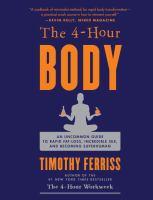 The 4-Hour BodyBy guest
by Tim Ferriss
“Andrew Huberman interviews Tim Ferriss about the research methodology behind The 4-Hour Body”
Tools
“SPONSORS: Element (https://drinklmnt.com/huberman)”
“SPONSORS: AG1 (https://drinkag1.com/huberman)”
“SPONSORS: Rora (https://rora.com/huberman)”
Gear
“Ferriss used this exact method to identify continuous glucose monitors as a mainstream health tool in 2009.”
More from Huberman Lab
We summarize every new episode. Want them in your inbox?
Access the Power of Now to Experience Life More Fully | Eckhart Tolle
Essentials: Nicotine's Effects on the Brain & Body & How to Quit Smoking or Vaping
Mushrooms for the Mind & Immune System | Paul Stamets
Essentials: How Emotions & Social Factors Impact Learning | Dr. Mary Helen Immordino-Yang
Overcome Addictions & Obsessions of All Kinds | Dr. Anna Lembke
Similar Episodes
Related episodes from other podcasts

The Tim Ferriss Show
Mar 5
#856: Jim Collins — What to Make of a Life and How to Maximize Your Return on Luck
The Tim Ferriss Show
Jul 29
#877: Q&A with Tim — The Art of Male Friendship, Mini-Retirements, Higher-Resolution Living, Reinvention in The Age of AI, and More
The Tim Ferriss Show
Jul 22
#876: Dr. Andrew Huberman — Peptides, Performance, and Protocols
The Tim Ferriss Show
May 20
#866: Sami Inkinen of Virta Health — Reversing Type 2 Diabetes, Rowing 2,750 Miles, and Lessons from Fixing Metabolic Health in 100,000+ People

On Purpose with Jay Shetty
Mar 18
Jay’s Must-Listens: Making Friends as an Adult Is Hard! (8 Powerful Lessons on Building Friendships That Last) Ft. Trevor Noah and Mel Robbins
Explore Related Topics
This podcast is featured in Best Health Podcasts (2026) — ranked and reviewed with AI summaries.
Read this week's Health & Longevity Podcast Insights — cross-podcast analysis updated weekly.
You're clearly into Huberman Lab.
Every Monday, we deliver AI summaries of the latest episodes from Huberman Lab and 192+ other podcasts. Free for one show.
Start My Monday DigestNo credit card · Unsubscribe anytime