A Better Way to Think About Tech
Episode
58 min
Read time
2 min
Topics
Marketing, Artificial Intelligence, Software Development
AI-Generated Summary
Key Takeaways
- ✓Techno Selectionism Framework: Neither rejecting all new technology nor accepting every innovation uncritically produces good outcomes. Newport's third path — techno selectionism — holds that individuals can enthusiastically adopt beneficial technologies like AI while simultaneously blocking specific harmful applications, such as algorithmic social media feeds targeting children, based on deliberate cost-benefit analysis rather than cultural pressure.
- ✓The Choosing C: No technology is mandatory regardless of cultural momentum or peer adoption. Newport's own decision to abandon social media in the 2010s, widely criticized at the time, is now considered unremarkable. Evaluate each tool individually: writer Brad Stolberg concluded LLMs actively degraded his creative output and declined use entirely, a legitimate techno selectionist position.
- ✓The Configuring C: Using a technology does not require accepting its default settings or unlimited access. Newport's 2019 Digital Minimalism framework recommends "fences" — structured rules governing use. Examples include restricting Instagram to a single 20-minute Friday session, or using a GoPro to capture content and delegating all platform interaction to a separate team member.
- ✓The Changing C: Adopting a technology creates no binding obligation to continue using it. Newport observes that legacy social platforms — Facebook, Instagram, Twitter — shifted from social-graph-based feeds to TikTok-style algorithmic content delivery, fundamentally altering the product users originally chose. Recognizing that a tool has changed or caused unforeseen harm justifies discontinuing use without justification.
- ✓The Complaining C: Individual pushback on institutional technology adoption produces measurable systemic change. Parental pressure, not new research, drove smartphone bans in schools across the United States in 2025. In 2026, 16 state legislatures proposed laws limiting classroom ed-tech screen time, again driven by organized parental complaints rather than top-down policy initiatives.
What It Covers
Cal Newport introduces "techno selectionism" as a practical middle path between techno pessimism and techno optimism. Using a map metaphor, he outlines four actionable strategies — choosing, configuring, changing, and complaining — that allow individuals to navigate technology adoption while maximizing benefits and minimizing personal and societal harm.
Key Questions Answered
- •Techno Selectionism Framework: Neither rejecting all new technology nor accepting every innovation uncritically produces good outcomes. Newport's third path — techno selectionism — holds that individuals can enthusiastically adopt beneficial technologies like AI while simultaneously blocking specific harmful applications, such as algorithmic social media feeds targeting children, based on deliberate cost-benefit analysis rather than cultural pressure.
- •The Choosing C: No technology is mandatory regardless of cultural momentum or peer adoption. Newport's own decision to abandon social media in the 2010s, widely criticized at the time, is now considered unremarkable. Evaluate each tool individually: writer Brad Stolberg concluded LLMs actively degraded his creative output and declined use entirely, a legitimate techno selectionist position.
- •The Configuring C: Using a technology does not require accepting its default settings or unlimited access. Newport's 2019 Digital Minimalism framework recommends "fences" — structured rules governing use. Examples include restricting Instagram to a single 20-minute Friday session, or using a GoPro to capture content and delegating all platform interaction to a separate team member.
- •The Changing C: Adopting a technology creates no binding obligation to continue using it. Newport observes that legacy social platforms — Facebook, Instagram, Twitter — shifted from social-graph-based feeds to TikTok-style algorithmic content delivery, fundamentally altering the product users originally chose. Recognizing that a tool has changed or caused unforeseen harm justifies discontinuing use without justification.
- •The Complaining C: Individual pushback on institutional technology adoption produces measurable systemic change. Parental pressure, not new research, drove smartphone bans in schools across the United States in 2025. In 2026, 16 state legislatures proposed laws limiting classroom ed-tech screen time, again driven by organized parental complaints rather than top-down policy initiatives.
Notable Moment
Newport highlights acclaimed journalist Lawrence Wright's research system for his Pulitzer-winning book — handwritten notes sorted into roughly 100 labeled manila folders. Newport argues this deliberately slow, analog process was not a liability but a cognitive asset, with the friction itself enabling the depth that produced the work.
Episode Transcript
Have you noticed that it's become increasingly hard to talk about technology? I think this is because a lot of commentators have divided themselves into two different groups, both of which can become pretty extreme. Alright? So on one side, we have what we can call the techno pessimist. Now the techno pessimist are worried about the harms that new technologies can cause and the things that we value that new technologies might make go away. I think the the classic example of techno pessimism would be the Luddite movement from the early eighteen hundreds who are worried about new automated manufacturing technologies like the steam loom and their input on artisan crafts. They felt really strongly about this. I have a letter here from 1812 written by members of the movement and signed by the the sort of fictional creation of general Ludd. And in this letter, they said they would rather die than see their children, which they called your neighboring fellow creatures, starve because hand weavers were gonna be put out of business. Now the thing about techno pessimists is that they're often right in the sense that the harms they're worried about are real, and they are harmful, and they do hurt. The issue with the techno pessimist is that sometimes we have to go through short term pain to get to long term innovation that ends up making everybody's lives better. If we go back to the Luddite movement, let's zoom out to the industrial revolution writ large. And what we see is, yes, for a lot of professions, the industrial revolution was very painful in the moment. Technopessimists of the time were right, but the industrial revolution also delivered essentially all of the wealth on which the modern world was built. We would not actually wanna be living in a world today in which the industrial revolution never happened. Okay. On the other extreme, we have what we can call the techno optimist who really don't care about short term harms or things we could lose in the... In right now, things we already value because they are often in love with this vision of some sort of much better future that the technology will deliver, and the short term cost in their mind is always worth it. This can get to pretty unnerving places. Like, let me play you a clip here. This is Elon Musk talking to Peter Diamandis about humankind and superintelligent AI. I mean, several years ago, I said humans are the biological bootloader for digital superintelligence. Yes. We are a transitional we are a transitional species. We're bootloader. Yeah. We're a bootloader. So what they're saying in this clip is that humans right now are essentially what they called biological bootloaders. Basically, just a step that gets us to the technological utopia they really care about, which is one in which we have a super intelligent AI that delivers us some sort of mystical world where, you know, everyone …
Get the full transcript (11,119 words) + summary by email — free
One-time email with the complete transcript and AI summary of this episode. No account needed.
One email, no spam. We’ll also show you what SignalCast does.

You just read a 3-minute summary of a 55-minute episode.
Get Deep Questions with Cal Newport summarized like this every Monday — plus up to 2 more podcasts, free.
Pick Your Podcasts — FreeKeep Reading
More from Deep Questions with Cal Newport
Do Hard Things (Featuring: Jerry Seinfeld)
Oct 30 · 15 min

Stuff You Should Know
Stand-Up Pt II
Oct 8
More from Deep Questions with Cal Newport
When Productivity Theory Meets Practice
Oct 26 · 66 min

Invest Like the Best with Patrick O'Shaughnessy
Andrew Huberman - The Frontier of Neurotechnology - [Invest Like the Best, EP.494]
Oct 6
Books, tools, and gear mentioned in this episode
SignalCast may earn commission on purchases via these links. As an Amazon Associate, SignalCast earns from qualifying purchases.
Books
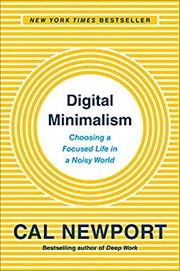
by Cal Newport
“Newport's 2019 Digital Minimalism framework recommends "fences" — structured rules governing use. Examples include restricting Instagram to a single 20-minute Friday session, or using a GoPro to capture content and delegating all platform interaction to a separate team member.”
Tools
by Meta
“Examples include restricting Instagram to a single 20-minute Friday session, or using a GoPro to capture content and delegating all platform interaction to a separate team member.”
More from Deep Questions with Cal Newport
We summarize every new episode. Want them in your inbox?
Do Hard Things (Featuring: Jerry Seinfeld)
When Productivity Theory Meets Practice
Why Did Big Tech Stop Building Useful Products?
“Rogue” AI Not Inevitable. It’s a Choice.
An Unlikely Team Tackles AI Brain Rot
Similar Episodes
Related episodes from other podcasts

Stuff You Should Know
Oct 8
Stand-Up Pt II

Invest Like the Best with Patrick O'Shaughnessy
Oct 6
Andrew Huberman - The Frontier of Neurotechnology - [Invest Like the Best, EP.494]

Software Engineering Daily
Oct 1
The State of Browser Testing

All-In with Chamath, Jason, Sacks & Friedberg
Sep 22
Blake Scholl: Why Plane Speed Stalled, Supersonic Commercial Flight, & Revolutionizing the Engine

The Diary of a CEO
Sep 14
The Man Who Predicted The Iran War: The Next 9/11 Will Target Your Bank Account! | Professor Jiang
Explore Related Topics
This podcast is featured in Best Mindset Podcasts (2026) — ranked and reviewed with AI summaries.
Read this week's AI & Machine Learning Podcast Insights — cross-podcast analysis updated weekly.
You're clearly into Deep Questions with Cal Newport.
Every Monday, we deliver AI summaries of the latest episodes from Deep Questions with Cal Newport and 192+ other podcasts. Free for one show.
Start My Monday DigestNo credit card · Unsubscribe anytime